Everyone worries about gravity. It is the glamorous unsolved problem — the one that won't quantize and the one the grand unified theories are chasing. Meanwhile a far stranger thing is attached to your refrigerator door and you think nothing of it.
Hold two magnets near each other and you can feel it: a push, or a pull, across a gap of empty air. Nothing touches. We measure the effect to twelve decimal places, we manufacture it by the billions, we build electric motors and MRI scanners and the wireless charger your phone sits on; all utilizing it. But if you ask a physicist what magnetism is — not how to compute it, but what it really is — the answer is equations, not a simple physical description of why magnets repel or attract.
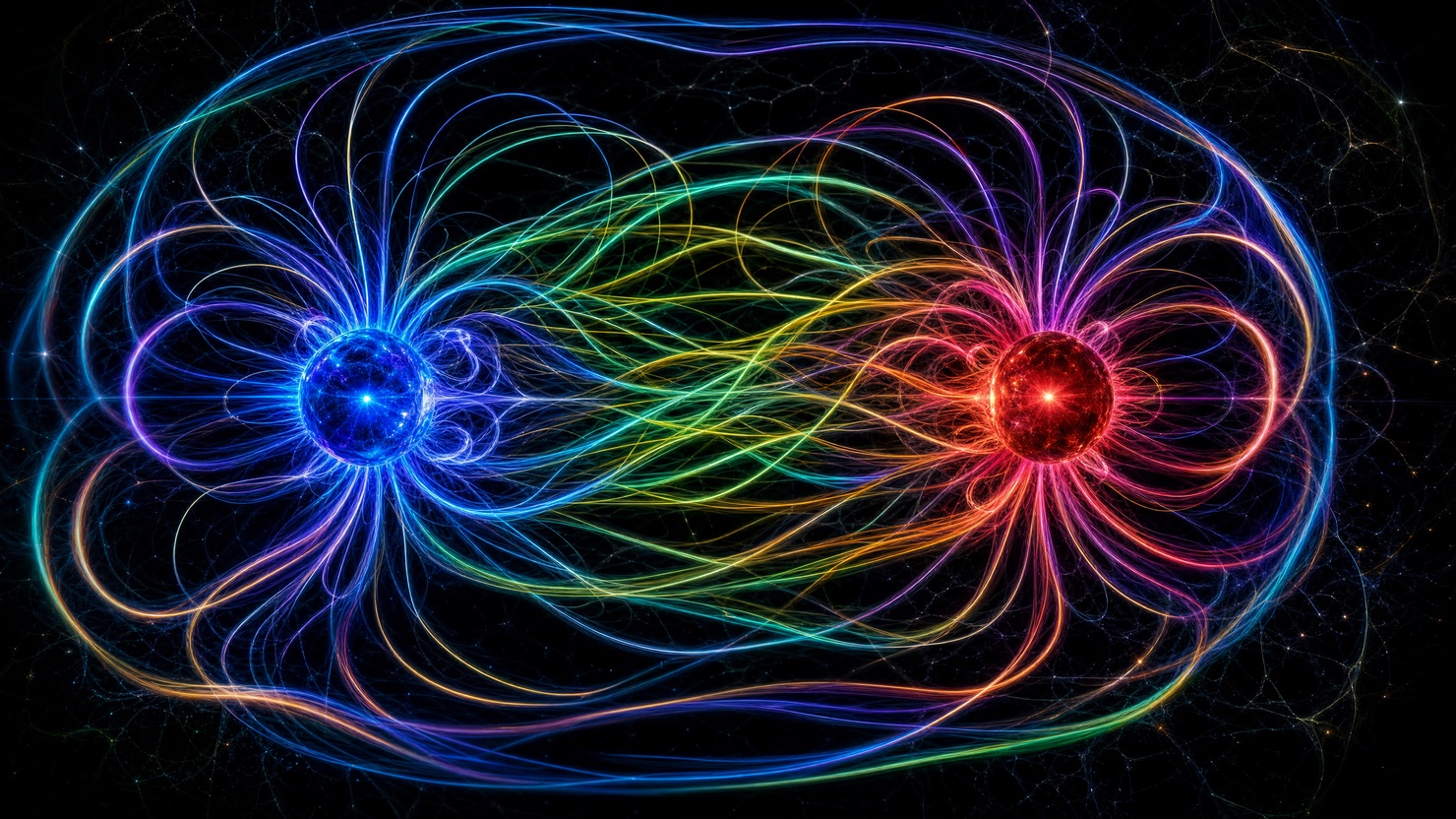
1 We Describe Magnetism as a Flow
Look at the words. Flux. Field lines. Lines of force. Circulation. The entire vocabulary of magnetism is the vocabulary of something moving. We draw the lines streaming out of the north pole and curving back into the south. We put arrows on them. We speak of flux through a surface, as though something were passing through it.
Then, having written down the mathematics of a flow, we turn around and insist that nothing is flowing and there is nothing for it to flow through. The description describes a current. This is the same error I have written about before — don't explain, don't observe, just calculate.
2 Lines That Cannot End
One of Maxwell's four equations is simply ∇·B = 0. Which, in words, means: magnetic field lines have no sources and no sinks. They never begin anywhere and never end anywhere. They can only close on themselves, looping back to where they started.
In 1858 Hermann von Helmholtz proved that in an ideal fluid, a vortex filament cannot begin or end within the fluid. It must close into a loop, and the strength of its circulation is conserved along its entire length.
A magnetic field obeys, point for point, the theorems Helmholtz derived for vortex filaments in a fluid. A permanent magnet sitting in a hard vacuum lays down filament structures that follow the rules of fluid vorticity exactly — closed, unbreakable, strength-conserving.
Either it is an astonishing convenience that magnetism obeys the mathematics of a fluid that supposedly isn't there — or it isn't a coincidence.
3 After Maxwell We Ignored The Fluid
When James Clerk Maxwell first wrote down the theory of electromagnetism — On Physical Lines of Force, 1861 — he did not start from abstract fields. He started from a mechanical model of a fluid filled with spinning vortices. He pictured a medium, packed it with rotating cells, and worked out how they would have to push on one another. Out of that fluid machine fell the displacement current, and out of the displacement current fell light itself, travelling at exactly the measured speed.
The equations were born from a fluid of vortices. Only later were they abstracted into pure field relations, and the fluid forgotten. We kept the mathematics that the model produced and discarded the model that produced it.
4 The Terms "Field" and "Virtual Photons" Are Placeholders
Ask today: how does the force cross the gap? You will be told it is a field, or that it is the exchange of virtual photons. Notice what these are. They are answers of the form we need some explanation, so here is one that lets us compute. A field is a force in a direction at every point while the virtual photon is an off-shell term in a perturbation series — a thing defined precisely by its being unobservable, a bookkeeping entry you can never point to.
Both explanations give you the number, they do not give you the medium. And they say nothing at all about the one thing the field is visibly doing — flowing in closed, conserved filaments through what we are taught is nothing.
5 Even Where There Is Nothing
Next you should ask, why do magnets work in space? We are told from day one that space is empty, nothing there, just a void. But the "nothing" turns out to have properties. Empty space has a measured magnetic permeability, μ₀ — a number describing how the void responds to magnetism. It has an electric permittivity, ε₀. It has an impedance of about 377 ohms. The speed of light is proportional to both: c = 1/√(μ₀ε₀).
A magnet works just as well out in the vacuum of space, far from any air or matter. Thus either Helmholtz is wrong or whatever the lines are threading through is present even where we insist there is nothing. For the fields to work, the "nothing" carries energy and momentum across the gap, and it obeys the theorems of a fluid.
I have no idea what the "nothing" is - today. That is perhaps for a different day. I am suggesting that you consider the contradiction. The most ordinary force in your daily life may likely be the key to unraveling the nature of the Universe. We need to start observing — no matter where those observations lead. I am suggesting that the real question is not how do we compute the field — we do that beautifully. Instead the critical question is the one we have trained ourselves not to ask:
What is flowing?