Every claim physics makes about the world is, at bottom, a claim about a measurement. We talk as though observation were a clear window onto reality — look, and the universe simply shows itself. But there is no observation that is not also an interaction: a needle deflected, a photon absorbed, a current counted, a neuron made to fire. What we call seeing is a chain of measurements, and a chain only ever reports what its links are built to register.
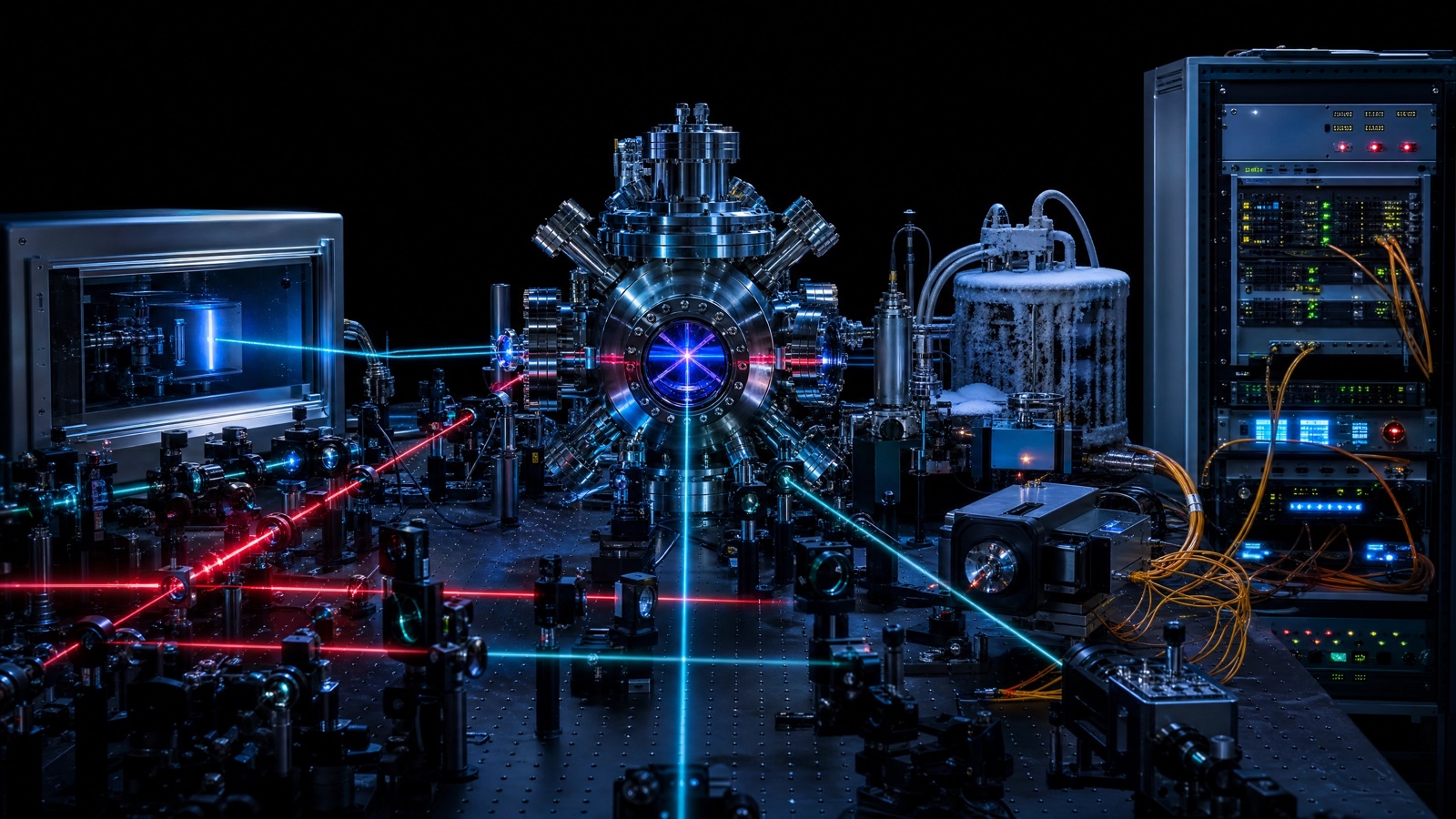
This is the companion problem to one I have written about before: there I argued that physics had mistaken its equations for its subject matter. Here the trouble is one layer deeper, and it is not about the math at all. It is about the instruments — and about what they are made of.
1 The Tools Are Made of What They Measure
Here is the constraint we rarely say out loud. Every instrument we possess — the interferometer, the detector, and the eye and cortex reading their output — is itself assembled from the same existence it is being used to examine. Our rulers are built from the very stuff we are measuring with rulers. The observer, the apparatus, and the observed are cut from one cloth.
For most of physics this doesn't matter. When you measure one thing against another — a length against a metre, a charge against an electron — the two differ, and the difference is what the measurement reads. The method works precisely because there is a contrast to register.
It is like asking water to taste water, when the taste buds themselves are made of water. There is no contrast to report, no edge to register against — the very sameness that makes the question seem natural is what makes it unanswerable.
The nature of our existence is not one thing among others that we might hold up against a standard. It is the condition all of those things share. And against a condition you share completely, there is nothing to measure.
2 A Limit, Not a Gap
It is tempting to read this as a temporary shortfall — colder traps, larger colliders, sharper detectors, and eventually we will get there. That instinct is usually right in physics. It is wrong here, and wrong in a specific way.
This is not a gap in our instruments. It is a property of where the instruments stand. You cannot step outside the nature of your own existence to aim a device back at it, because the stepping, the aiming, and the device are already within it and made of it. There is no vantage point that is not also a participant.
This is not mysticism; it is bookkeeping. A measurement requires two things that differ. Where observer, instrument, and observed share the same nature without remainder, the difference the measurement would read is exactly the difference that isn't there.
3 Fingerprints at the Edge
And yet the absence of a measurement is not the absence of evidence.
We may never put the nature of our existence on the table as a number — but we can watch where our descriptions stop working. Every model has a domain, and at the boundary of that domain things happen the model did not order: residues, anomalies, effects with no cause anywhere inside the theory. A single such discrepancy is noise. A persistent, structured one is a fingerprint.
Much of physics is, quietly, the history of taking those fingerprints seriously — the precession that shouldn't precess, the energy that goes missing, the line in the spectrum that has no business being there. Each was a place where something made itself felt without ever showing its face. We did not need to see the source to infer the pressure of its presence; we only needed to stop dismissing the mark it left.
So the honest position is neither "we will eventually measure it" nor "it is unmeasurable and therefore meaningless." It is this: what we are part of may never be observed directly, and may still announce itself — indirectly, stubbornly — in the gaps.
Shut up and observe still holds. We just have to be clear-eyed that some of what we are observing for will never arrive as a tidy reading on a dial. It will show up, if it shows up at all, in the residue our theories cannot absorb — and learning to read that residue may turn out to be the whole game.